
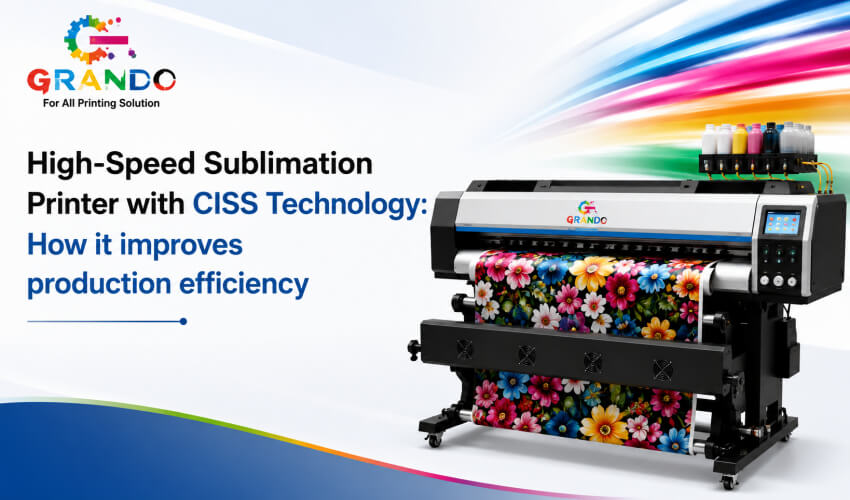
When manufacturers evaluate a high-speed sublimation printer, most of the conversation focuses on printhead count, print width, and output speed. But one component quietly determines whether that speed actually translates into consistent production output: the Continuous Ink Supply System (CISS).
A high-speed sublimation printer with CISS can run as fast and as reliably as its ink delivery allows, which is exactly why more manufacturers are choosing this configuration over cartridge-based machines. This article breaks down what CISS does, why it matters for production efficiency, and what to check before choosing a sublimation printer machine built around it.
What Is CISS in a Sublimation Printer?
A continuous ink supply system replaces small, frequently changed ink cartridges with large external ink tanks connected directly to the printheads through a continuous feed line. Instead of stopping production every time a cartridge runs low, the machine draws ink continuously from a bulk reservoir throughout the run.
For textile printing machines running long production shifts, this design improves uptime. It also reduces costs and maintains consistent print stability.
How CISS Improves Production Efficiency
1. Fewer Production Interruptions
Cartridge-based systems require frequent stops to swap ink, and each stop risks introducing air bubbles, pressure fluctuations, or minor color shifts when production resumes. A CISS-equipped fabric printing machine keeps a stable, continuous ink flow for hours of uninterrupted printing, which directly reduces avoidable downtime.
2. Better Ink Optimization and Lower Cost Per Meter
Bulk ink tanks reduce packaging waste and allow manufacturers to buy sublimation ink in larger, more cost-efficient volumes. Combined with stable pressure control, CISS supports better ink optimization—less waste from partially used cartridges and more predictable ink cost per meter of fabric printed.
3. Stable Pressure for Consistent Print Resolution
Print quality depends heavily on consistent ink pressure reaching the printhead. CISS systems are engineered to maintain steady flow and pressure regardless of tank level, which helps protect print resolution and color consistency across long runs—something cartridge systems struggle to match once ink levels run low.
4. Reduced Printhead Stress
Frequent cartridge changes and the air exposure that comes with them can contribute to nozzle clogging over time. A well-designed CISS minimizes air intake into the ink line, supporting more stable printhead performance and reducing the frequency of deep-cleaning cycles.
5. Supports True High-Speed Production
Multi-head sublimation printers designed for industrial textile printing need an ink delivery system that can keep pace with high-speed printhead arrays. Without a properly engineered CISS, even the fastest printhead configuration will bottleneck on ink supply. A true high-speed sublimation printer with CISS sustains its rated speed across full production shifts, not just short test runs—that consistency is what separates it from a standard cartridge-fed machine.
What to Check in a CISS-Equipped Sublimation Printer
Not all CISS setups are built the same. Before investing in a digital sublimation printing machine, manufacturers should evaluate:
- Tank capacity relative to shift length and production volume
- Ink line material and resistance to clogging or degradation
- Pressure regulation quality across all printheads simultaneously
- Ease of monitoring ink levels during production
- Compatibility with the specific sublimation ink formulation being used
CISS and Ink Compatibility
CISS performance is closely tied to the ink itself. Using ink not formulated for continuous-flow systems can lead to sedimentation, viscosity issues, or uneven pigment distribution over long runs. Manufacturers should always match their CISS setup with a sublimation ink designed for continuous flow. This helps maintain a reliable print workflow and consistent performance.
Frequently Asked Questions
1. What does CISS stand for in sublimation printing?
Ans: CISS stands for Continuous Ink Supply System, a bulk ink delivery setup that feeds printheads directly from external tanks instead of small cartridges.
2. Does CISS improve print quality, or just speed?
Ans: Both. Stable, uninterrupted ink flow supports consistent pressure at the printhead, which directly protects color accuracy and print resolution, not just output speed.
3. Is CISS suitable for small-scale sublimation printing businesses?
Ans: Yes, though the cost-benefit becomes more significant at higher production volumes, where reduced downtime and lower ink cost per meter have the biggest impact.
4. How often does a CISS system need maintenance?
Ans: Ink lines and filters should be checked regularly as part of routine maintenance, though CISS generally requires less frequent intervention than cartridge-based systems.
5. Can any sublimation ink be used with a CISS-equipped printer?
Ans: Not always. Ink should be specifically suited for continuous-flow systems to avoid sedimentation or flow inconsistency over long production runs.
6. Does Grando India offer high-speed sublimation printers with CISS built in?
Ans: Yes. The cost benefits become much greater at higher production volumes. Reduced downtime and lower ink cost per meter deliver the biggest savings.
Built for Continuous, High-Volume Production
A high-speed sublimation printer with a CISS is only as productive as its ink supply allows. Grando India, based in Surat, Gujarat, designs sublimation printing machines with CISS integrated for stable ink flow, reduced downtime, and consistent print resolution across long production runs.
Explore our 16-head sublimation printer range or sublimation printer ink built for continuous flow performance, and read our guide on printhead maintenance to keep your machine running at peak efficiency.
Request a live demonstration, technical consultation, or quotation from Grando India by contacting our team today.