
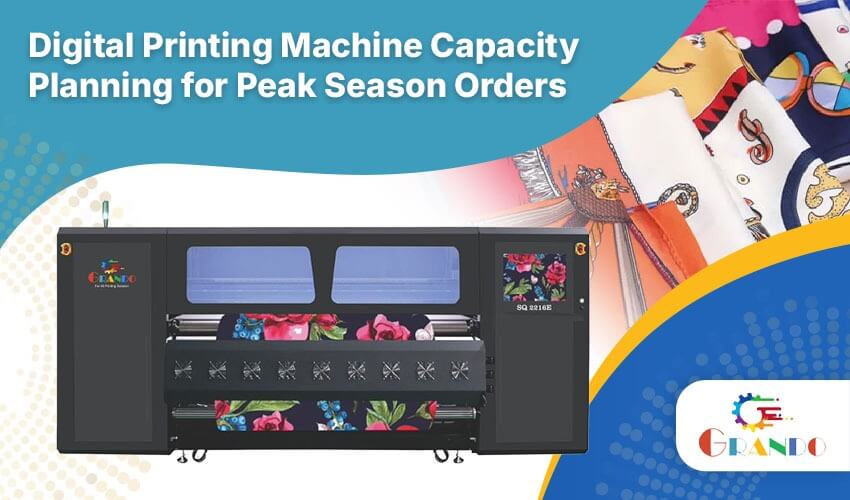
Every process house learns the same lesson eventually: peak season doesn’t fail because orders are too big—it fails because digital printing machine capacity planning happens after the order book is already full, not before. Festive-season, export, and back-to-school order spikes are predictable events on a calendar. Treated as a planning problem months in advance, they become a growth opportunity. Treated as a surprise, they become missed delivery dates, rushed subcontracting, and unhappy buyers.
India’s textile and apparel sector is heading into this peak cycle with real tailwinds behind it—the industry is tracking toward the $45–50 billion export range, and digital textile printing adoption continues to climb as global brands push for shorter lead times, smaller batch sizes, and faster replenishment. This demand doesn’t spread evenly across the year. It concentrates into a few key months, which is exactly when gaps in digital printing machine capacity become more visible.
Why Peak Season Exposes Weak Capacity Planning
Most process houses know their machine’s rated output—heads, print width, and rated speed. Manufacturers often overlook the gap between rated capacity and real production capacity after accounting for ink changeovers, maintenance, operator shifts, fabric changes, and rework. A high-speed digital printing machine quoted at a certain daily meterage on a spec sheet rarely holds that number once it’s running mixed SKUs, tighter color tolerances, and back-to-back priority orders.
Peak-season printing also compounds small inefficiencies. A 20-minute daily delay from an avoidable ink or nozzle issue is a rounding error in a slow month. Multiply it across 45 peak days with three shifts, and it’s the difference between hitting a shipment date and paying air-freight penalties to save it.
How to Calculate Real Production Capacity
Digital printing machine capacity planning should start with numbers from your own production logs rather than relying only on the machine’s brochure.
Usable daily output = (rated speed × operating hours) − (changeover time + maintenance time + rework rate)
Run this separately for each machine and each fabric/ink combination you commonly print, since sublimation printer output on polyester differs meaningfully from direct-to-fabric digital textile printers on cotton blends. Once you have a realistic per-machine number, multiply it against your peak-season order forecast to see where the shortfall actually is—extra shifts, an additional machine, or outsourcing overflow.
Signs Your Textile Printing Production Planning Needs a Rethink
A few patterns tend to show up in process houses that get caught out every peak season:
- Single-machine dependency: One digital fabric printing machine carrying the full order book means one breakdown becomes a missed shipment.
- No documented changeover time: If nobody can tell you how long an ink or fabric-type changeover actually takes, your capacity numbers are guesses.
- Reactive maintenance: Preventive maintenance gets skipped in-season “to keep the machine running,” which is usually when printhead and ink-supply issues cost the most downtime.
- No buffer for rework: Color mismatches and misprints on rush orders eat into capacity twice — once for the failed run, once for the reprint.
These factors can make your actual digital printing machine capacity considerably lower than the rated figure.
A Practical Capacity Planning Checklist Before Peak Orders Hit
- Forecast demand by week, not by season. Peak season printing rarely distributes evenly — map the actual order curve from last year against this year’s confirmed and expected orders.
- Audit real machine uptime, not rated uptime, over the last two quarters.
- Pre-stock ink, printheads, and spares before the season starts, not when a machine is already down.
- Lock in preventive maintenance dates before the peak window opens, not during it.
- Identify your overflow plan — a second shift, a backup machine, or a trusted subcontractor — before you need it.
- Review color management and print resolution settings per fabric type in advance, so peak-season runs don’t lose time to color-matching trial and error.
Following these steps gives process houses a more realistic picture of their available digital printing machine capacity before peak orders arrive.
Choosing the Right Digital Textile Printing Machine for Scale
If capacity audits consistently show you’re short every peak season, the honest fix is often production efficiency at the machine level, not just scheduling. This is where printhead technology and machine build matter: piezoelectric inkjet printheads with Variable Drop Technology hold print resolution steadier at higher speeds, a stronger color management system cuts rework-driven capacity loss, and a heavier, more stable machine chassis keeps output consistent during long, high-speed peak-season runs instead of degrading over a shift.
Grando India, based in Surat, works with process houses across Gujarat and India on exactly this kind of capacity math — matching 3-head, 4-head, 8-head, 12-head, 15-head, 16-head, and 20-head sublimation printers, direct-to-fabric printers, and position printers to real order volume rather than nameplate speed, backed by local spare-parts stock and fast service response so peak-season downtime doesn’t sink a delivery date.
Instead of looking only at nameplate speed, process houses can evaluate machine configuration against order volume, fabric type, operating hours, maintenance requirements, and expected digital printing machine capacity.
FAQs
Q1) How far in advance should I start peak season capacity planning?
Ans: Start at least 8–10 weeks before your peak window. This gives enough time to pre-order ink and spares, schedule preventive maintenance, and arrange overflow capacity if needed.
Q2) What’s the biggest capacity planning mistake process houses make?
Ans: Using the machine’s rated speed instead of real, logged output. Rated capacity ignores changeovers, maintenance, and rework — the real bottlenecks during peak orders.
Q3) Can upgrading printhead technology actually improve peak-season output?
Ans: Yes. Precision printheads with Variable Drop Technology and a solid color management system reduce misprints and color-matching rework, which is often where peak-season capacity is silently lost.
Q4) Should I buy a second machine or add a shift during peak season?
Ans: The answer depends on your production data and whether the capacity shortfall occurs regularly. Compare your forecasted demand with actual usable digital printing machine capacity before deciding between an additional shift, outsourcing, or investing in another machine.
Q5) How does machine build quality affect capacity planning?
Ans: Heavier, more stable machines maintain print consistency at high speed over long runs, so you lose less time to reruns — a real factor when calculating usable daily output for peak-season order planning.
Q6) Where can I get help planning digital printing machine capacity for peak orders?
Ans: Grando India’s Surat-based team reviews your current machine output, order forecast, and fabric mix, and recommends the right machine configuration or workflow fix—talk to the team here.
Don’t let peak season expose gaps you could have planned around. Get a capacity review from Grando India’s Surat team before your next order surge — book a consultation or request a quotation today.