
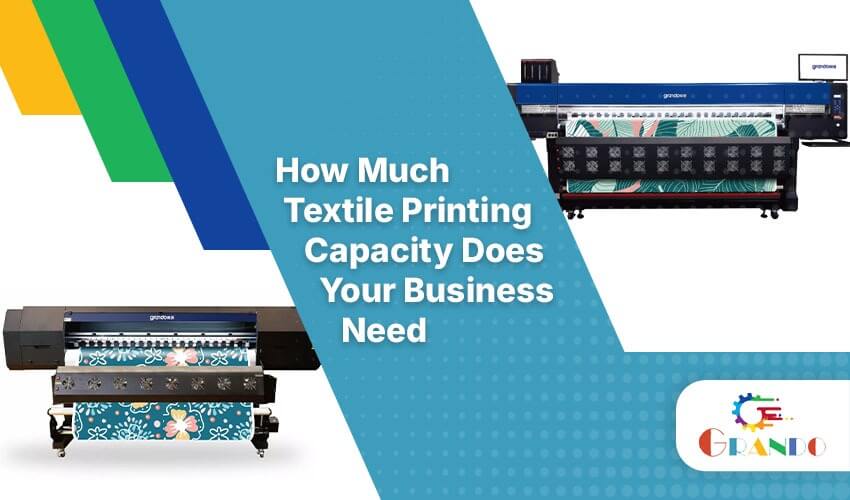
Buying a digital textile printing machine is not simply a question of choosing the fastest machine available. The more important question is: how much textile printing capacity does your business actually need?
A machine that is too small can create production delays when orders increase. A machine that is too large can leave expensive equipment underutilized during slower periods.
The right approach is to calculate your real textile printing capacity from actual order volume, realistic print speed, operating hours, fabric type, changeovers, maintenance, and expected peak demand.
This guide explains how to estimate the capacity your business needs before investing in a textile printing machine.
What Is Textile Printing Capacity?
Textile printing capacity is the amount of fabric a printing operation can realistically produce within a defined period, such as an hour, shift, day, or month.
It is usually expressed in square metres per hour or square metres per day, depending on the machine and production setup. However, the maximum speed listed on a machine specification sheet should not automatically be treated as its production capacity.
Actual output can be affected by:
- Print speed and selected pass mode
- Operating hours and number of shifts
- Fabric type and fabric handling
- Print resolution
- Color management requirements
- Job setup and changeover time
- Cleaning and maintenance
- Downtime
- Operator availability
- Ink and media handling
- Rework or rejected output
That is why capacity planning should start with your actual production workflow, not only the machine’s maximum rated speed.
How to Calculate Your Real Textile Printing Capacity
A simple starting formula is:
Real Production Capacity = Realistic Print Speed × Available Production Hours × Machine Utilization
For example, if a digital textile printing machine produces an effective 40 m²/hour, operates for 8 hours, and achieves 80% utilization: 40 × 8 × 0.80 = 256 m² per shift
This is a more useful planning number than simply multiplying the machine’s maximum rated speed by eight hours.
For monthly planning, you can extend the calculation:
Monthly Capacity = Realistic Hourly Output × Production Hours per Day × Working Days × Utilization
Your actual calculation should be based on the print settings and workflow you expect to use most frequently.
Key Capacity Factors
| Factor | Effect on Real Production Capacity |
|---|---|
| Rated print speed | Provides a starting reference but may not represent continuous production output |
| Print resolution | Higher-detail settings can reduce effective production speed |
| Pass mode | Additional passes can improve print quality while reducing output speed |
| Operating hours | More available production hours increase potential output |
| Fabric type | Fabric characteristics and handling requirements can affect workflow |
| Changeovers | Job setup and fabric changes reduce available printing time |
| Maintenance | Cleaning and scheduled maintenance reduce production hours |
| Downtime | Unexpected stoppages directly reduce usable capacity |
| Rework | Defective or rejected prints reduce saleable output |
| Operator workflow | Manual handling and setup can become production bottlenecks |
The capacity number you should plan around is the output you can consistently achieve during normal production—not the fastest number on the specification sheet.
Step 1: Calculate Your Current Order Volume
Start with your actual production data.
Review at least the previous several months and record:
- Average monthly printing volume
- Highest monthly printing volume
- Average daily order volume
- Number of working days
- Typical order size
- Fabric types being printed
- Frequently used print modes
- Number of production shifts
For example, suppose your business currently prints: 6,000 m² per month
If you operate for approximately: 25 days × 8 hours = 200 production hours per month
Your average required output is: 6,000 ÷ 200 = 30 m²/hour
That gives you a starting point for evaluating machine capacity.
However, average demand should not be your only reference. You should also examine your busiest production periods.
Step 2: Separate Average Demand From Peak Demand
Peak demand is one of the most important factors in textile printing capacity planning.
If your normal monthly requirement is 6,000 m² but your busiest months reach 8,000 m², purchasing a machine based only on the 6,000 m² average could leave you short of capacity during peak periods.
At the same time, purchasing equipment specifically for the highest possible demand can result in underutilization during quieter months.
A better approach is to compare: Average demand + peak demand + expected growth before deciding on machine configuration.
If peak orders are temporary, alternatives may include:
- Adding another production shift
- Improving machine utilization
- Reducing changeover time
- Scheduling preventive maintenance outside production periods
- Using additional production capacity when required
- Adding a second machine when demand becomes consistent
The right solution depends on your order pattern and production economics.
Step 3: Use Realistic Machine Speed
Machine specifications can provide useful technical information, but rated speed should not automatically become your business planning number.
Print speed can vary according to:
- Resolution
- Pass mode
- Number and configuration of printheads
- Fabric
- Ink
- Color requirements
- Artwork complexity
- Production workflow
For example, Grando’s current textile-printing range includes different machine configurations and technologies. Its 8-head sublimation printer page lists different production figures for different print modes, demonstrating why the selected production setting matters when estimating capacity.
The same principle applies across digital textile printing: the speed you use for most commercial jobs is more important for capacity planning than the theoretical maximum.
Step 4: Consider Print Quality and Resolution
Capacity is not only about square metres per hour.
A business producing detailed fashion patterns, photographic designs, gradients, or demanding color requirements may use different print settings from a business producing simpler designs.
Higher print resolution or additional passes can affect production speed.
This means two businesses using the same digital textile printing machine can achieve different practical production capacities.
Before purchasing, identify the settings you actually expect to use for your main customer orders.
Step 5: Account for Changeovers and Downtime
A machine may be capable of printing continuously, but real production includes activities between jobs.
These can include:
- Fabric loading
- Fabric changes
- Job setup
- Printhead checks
- Cleaning
- Maintenance
- Ink replenishment
- Troubleshooting
- Calibration
- Test prints
For example, if a machine is technically available for eight hours but only seven hours are realistically available for productive printing, your capacity calculation should use the productive time—not the full eight-hour shift.
This distinction is particularly important when comparing machines with different automation levels and production workflows.
Step 6: Match Capacity to Fabric Type
Fabric type can influence the printing process and effective output.
Depending on the application, businesses may work with polyester, cotton, blends, or other textile materials. Different printing technologies and workflows may be appropriate for different fabric requirements.
For example, sublimation printing is commonly associated with polyester-based textiles, while DTF systems can support a wider range of garment and textile applications. Grando’s current DTF system documentation describes applications including cotton, polyester, blends, nylon, leather, and other materials.
Therefore, capacity planning should consider what you print, not just how much you print.
Step 7: Calculate Your Required Capacity
Once you have your production data, bring everything together.
Use this basic calculation: Required Capacity = Expected Production Volume ÷ Available Production Hours
Then account for utilization and peak demand.
Example
Suppose your business expects:
- Monthly requirement: 8,000 m²
- Working days: 25
- Working hours: 8 per day
Available production time: 25 × 8 = 200 hours
Required average output: 8,000 ÷ 200 = 40 m²/hour
If you expect downtime, changeovers, maintenance, and other production losses, the machine should not be selected simply because its specification says 40 m²/hour.
You need sufficient practical capacity to produce the required volume within your available production time.
How Much Capacity Should You Keep for Growth?
There is no universal capacity buffer that works for every textile printing business.
The right amount depends on:
- Historical order growth
- Customer pipeline
- Seasonal demand
- Production shifts
- Available floor space
- Investment budget
- Cost of outsourcing overflow work
- Expected utilization
Instead of applying an arbitrary percentage, calculate your expected demand for the next planning period and compare it with your current real production capacity.
For a growing business, it can make sense to have some additional capacity available. But excessive unused capacity can tie up capital and floor space.
Should You Buy a Bigger Textile Printing Machine?
A larger machine may make sense when:
- Your existing machine is consistently near its practical limit
- Order volume is growing steadily
- Peak demand regularly exceeds available capacity
- You have enough production work to keep the machine utilized
- Additional capacity can reduce outsourcing or overtime
- Your production workflow can support the additional output
A smaller or more flexible setup may make more sense when:
- Demand is still unpredictable
- Orders are mainly small batches
- Current machine utilization is low
- Growth projections are uncertain
- You have limited floor space or capital
The objective is not to buy the largest machine. The objective is to build enough reliable production capacity for the business model you actually have.
How Peak Season Changes Capacity Planning
Textile businesses can experience significant changes in demand during specific periods. Instead of using one unusually busy month to determine machine size, compare your production history across multiple periods.
Ask:
- What is our average monthly volume?
- What was our highest monthly volume?
- How long does peak demand normally last?
- How much additional capacity did we actually need?
- Could an additional shift handle the increase?
- Would outsourcing temporary overflow be more economical?
- Is the higher demand likely to continue?
This helps distinguish temporary peak demand from permanent capacity requirements.
Why Machine Utilization Matters
Machine utilization is an important part of capacity planning. Consider two businesses with identical machines.
Business A
- High order volume
- Long production runs
- Few changeovers
- Consistent utilization
Business B
- Smaller orders
- Frequent artwork changes
- More fabric changes
- Longer setup periods
- Lower utilization
Even though both businesses own the same machine, their actual production capacity can be very different. This is why machine utilization, workflow, and order structure should be considered alongside print speed.
Capacity Planning for Digital Textile Printing in Surat
For textile businesses in Surat and Gujarat, capacity planning can be particularly important because production requirements can vary between textile manufacturers, fabric printers, garment businesses, exporters, and job-work operations.
Grando India is based in Surat and provides digital textile printing solutions including sublimation, direct printing, position printing and related printing consumables and spare parts.
The company also provides machine configurations for different production requirements, which makes it useful to evaluate capacity according to the actual application rather than selecting equipment based only on a headline speed.
How Grando India Can Help With Capacity Planning
Before choosing a textile printing machine, it is useful to discuss the production requirements in practical terms:
- Current monthly order volume
- Expected growth
- Fabric types
- Required print quality
- Working hours
- Number of shifts
- Peak-season requirements
- Current production bottlenecks
- Required machine width
- Printhead configuration
- Printing technology
Grando’s current product range covers multiple digital printing applications, including sublimation and DTF systems, allowing machine selection to be considered alongside the intended production workflow.
If you are unsure about the capacity you need, share your approximate monthly order volume, fabric type, working hours, and current production setup with the Grando team before selecting a machine.
Get a Textile Printing Capacity Estimate
A Simple Textile Printing Capacity Checklist
Before buying a digital textile printing machine, calculate:
- Average monthly order volume
- Peak monthly order volume
- Expected growth
- Working days per month
- Hours per shift
- Number of shifts
- Realistic print speed
- Typical print resolution
- Pass mode used most often
- Fabric types
- Average changeover time
- Maintenance requirements
- Historical downtime
- Required production buffer
- Available floor space
- Budget and operating costs
This gives you a much clearer picture of the machine capacity your business actually requires.
Frequently Asked Questions
Q1) How do I calculate textile printing capacity?
Ans: Calculate your realistic production speed in square metres per hour, multiply it by productive operating hours, and account for machine utilization, changeovers, maintenance, and downtime. For example, a machine producing 40 m²/hour for 8 hours at 80% utilization would provide approximately 256 m² of productive capacity per shift.
Q2) What factors affect textile printing machine capacity?
Ans: Important factors include print speed, pass mode, resolution, printhead configuration, fabric type, operating hours, changeovers, maintenance, downtime, operator workflow, and machine utilization.
Q3) Is rated print speed the same as actual production capacity?
Ans: No. Rated speed is a technical reference. Actual production capacity can be lower because of print settings, fabric handling, setup, cleaning, maintenance, downtime, and other workflow requirements.
Q4) How much capacity should a textile printing business keep for growth?
Ans: There is no single percentage that applies to every business. Capacity should be based on historical demand, expected growth, seasonal requirements, available production hours, and the cost of adding or outsourcing capacity.
Q5) Does fabric type affect textile printing capacity?
Ans: Yes. Different fabrics and printing technologies can require different workflows and settings. The appropriate machine and practical output should therefore be evaluated according to the fabrics and applications you actually produce.
Q6) Does print resolution affect machine capacity?
Ans: Yes. Higher-resolution or multi-pass printing can require more printing time. When calculating capacity, use the print settings you expect to use for the majority of commercial orders.
Q7) How does downtime affect textile printing capacity?
Ans: Downtime directly reduces productive printing hours. Cleaning, maintenance, troubleshooting, setup, and unexpected stoppages should be considered when estimating realistic production output.
Q8) Can Grando India help calculate the textile printing capacity I need?
Ans: Yes. Grando India can discuss your order volume, fabric type, operating schedule, printing requirements, and production goals to help identify a suitable machine configuration. Grando is based in Surat and serves textile and printing businesses across Gujarat and India.
Conclusion
Choosing the right textile printing capacity is not about buying the machine with the highest advertised speed.
It starts with understanding your actual order volume, productive operating hours, fabric requirements, print settings, machine utilization, downtime, and peak demand.
Calculate your current production requirement first. Then compare that number with realistic machine output and your expected future demand.
For businesses in Surat, Gujarat, and across India, Grando provides digital textile printing solutions covering different production applications, including sublimation and DTF systems.
If you already know your monthly order volume and working hours, you can use those numbers as the starting point for a machine-capacity discussion.
Talk to Grando India About Your Production Capacity