
If you’re researching a direct to garment printing machine for your apparel business, you’ve probably seen it compared with DTF printing. However, the two technologies work differently. This guide explains how DTG printing works, who it suits best, and what to consider before choosing a garment printing technology in 2026.
DTG has grown into one of the fastest-adopted technologies in custom apparel production, and the appeal is straightforward: it applies full-colour, photo-level designs directly onto t-shirts, hoodies, and similar garments with a soft hand feel and no fixed batch size. That flexibility makes it a strong fit for print-on-demand sellers, custom t-shirt studios, e-commerce apparel brands, and promotional print runs — businesses that need variety and quick turnaround more than raw volume. For units scaling past single-piece orders into bulk and multi-fabric production, Grando’s DTF T-shirt printing system is built to pick up exactly where that volume threshold begins.
Why Businesses Are Moving Towards Digital Garment Printing
The Indian apparel industry is rapidly adopting digital garment printing because it allows faster production, lower setup costs, and complete design flexibility. Whether you’re producing custom T-shirts, fashion wear, promotional clothing, or personalised merchandise, modern digital garment printing machines make production faster and more flexible. They eliminate lengthy screen setup and make short-run printing commercially viable.
Businesses looking for the best direct to garment printers, digital print garments, or digital printing on garment Surat often compare DTG and DTF printing. They want to find the most profitable production method. Understanding the strengths of each technology helps you invest in the right solution for your business.
What Is a Direct to Garment Printing Machine?
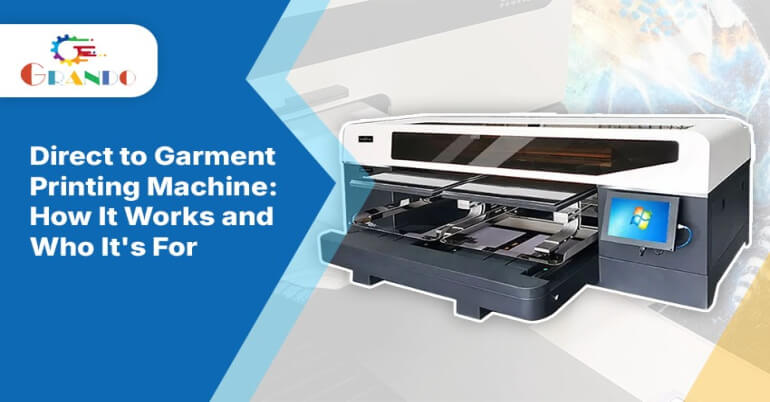
A direct to garment printing machine — often shortened to DTG — prints digital designs straight onto the surface of a finished fabric item, usually a T-shirt, using specialised inkjet technology and textile-grade inks. Unlike screen printing, there’s no film, no transfer paper, and no plate setup. The garment is loaded onto a flat platen, the design is sent from RIP software, and the printhead applies ink layer by layer directly onto the fibres.
This makes direct to garment printing especially popular for short runs, personalised orders, and designs with complex colour gradients or photographic detail that other methods struggle to reproduce cleanly.
Why DTG Is Considered Digital Garment Printing
A direct to garment printing machine is one type of digital garment printing machine that prints artwork directly onto finished garments. Since every design is created digitally, businesses can print unique artwork without making screens or plates. This makes digital garment printing ideal for personalised clothing, fashion brands, eCommerce sellers, and custom merchandise businesses that frequently change designs.
How Direct to Garment Printing Machines Work: Step by Step
- Pre-treatment: Cotton-heavy garments are treated with a pre-treatment solution so ink bonds properly to the fibre.
- Design loading: The artwork is processed through RIP software and colour-profiled for the fabric type.
- Printing: The direct to garment machine lays down white ink first (for dark fabrics), followed by CMYK layers.
- Curing: The garment passes through a heat press or curing oven to bond the ink permanently.
The result is a soft-hand print with strong colour depth — but the pre-treatment and curing steps also explain why direct to garment printing machines tend to run slower per piece than film-based methods for high-volume orders.
Who Is Direct to Garment Printing Really Suited For?
- On-demand and personalised apparel brands printing single pieces or small batches per design
- Cotton-focused garment businesses, since DTG performs best on natural fibres
- Studios producing photo-quality or gradient-heavy artwork that benefits from direct ink deposition
Where DTG becomes less practical is bulk production across mixed fabric types, fast fabric-to-fabric turnaround, or printing on non-cotton and blended materials — this is exactly where a different digital garment printing route earns its place.
DTG vs DTF: The Practical Difference for Indian Garment Businesses
This is the question most buyers are actually trying to answer when they search for a direct to garment printing machine price. DTF (Direct-to-Film) prints the design onto a transfer film first, applies an adhesive powder, then heat-presses it onto the garment. Because the print isn’t bonded directly to raw fibre, DTF works well on cotton, polyester, blends, bags, and caps. It also doesn’t require the pre-treatment needed for DTG.
For most growing Indian garment and textile units — where order books mix fabric types and speed matters as much as finish — DTF has become the more flexible and cost-efficient digital printing route, particularly for bulk and multi-fabric production.
This is the technology Grando India, Surat has built its garment printing line around. Our DTF T-shirt printing machine with an automatic belt system and powder shaker is engineered for exactly this kind of high-speed, multi-fabric production — running I3200 printheads across CMYK+W ink channels with continuous ink supply for stable, low-maintenance output.
If you’re comparing entry points, our guides on DTF machines for small businesses and choosing the right DTF system walk through setup costs and production scale in more depth.
Why Many Indian Garment Manufacturers Prefer DTF Printing
Although DTG produces excellent print quality on cotton garments, many growing manufacturers now choose DTF Printing because it offers greater flexibility across multiple fabrics and production volumes.
Compared to traditional DTG systems, a modern DTF T-shirt printing system allows businesses to print on:
- Cotton
- Polyester
- Blended fabrics
- Hoodies
- Bags
- Caps
- Uniforms
- Promotional garments
For businesses looking for scalable digital printing on garment solutions, DTF often delivers better production speed, reduced maintenance, and lower operating costs.
Grando India’s industrial DTF T-shirt printing system is designed specifically for Indian garment manufacturers that need reliable production, consistent print quality, and long-term business growth.
What to Check Before You Invest, Whichever Route You Choose
- Fabric range you’ll actually print on — cotton-only or mixed?
- Average order size — single pieces or bulk batches?
- Total cost including pre-treatment/film consumables, not just machine price
- After-sales support, spare parts availability, and technician access in Grando itself
Ready to Upgrade Your Garment Printing Business?
Whether you’re comparing the best direct to garment printers or looking for a high-production DTF Printing solution, choosing the right machine can significantly improve your production speed, profitability, and print quality.
Why Choose Grando India?
- Live Machine Demonstration in Surat
- Expert Consultation Based on Your Business
- Industrial-Grade DTF T-shirt Printing System
- Installation & Operator Training
- Spare Parts & Technical Support
- Suitable for Startups & Large Garment Factories
Book Your FREE Live Demo Today
Discover how Grando’s digital garment printing machine can help you produce more garments, reduce operating costs, and grow your apparel business with confidence.
Call Now for Pricing & Live Demo
Visit Our Surat Experience Centre
👉 Get Your Custom Machine Recommendation Today
Frequently Asked Questions
Q1) Is a garment printing machine good for small businesses?
Ans: Yes, for low-volume, high-customisation orders on cotton garments. For mixed fabrics or bulk runs, a DTF setup is usually more cost-efficient per piece.
Q2) What fabrics work best with direct to garment printing?
Ans: DTG performs best on 100% cotton or cotton-heavy blends. Polyester and synthetic blends print more reliably with DTF or sublimation.
Q3) Is DTG or DTF cheaper to run long-term?
Ans: DTG has lower per-unit cost on small cotton runs but higher consumable and maintenance overhead. DTF typically wins on running cost across bulk, multi-fabric production.
Q4) Does Grando India sell direct to garment printing machines?
Ans: Grando India, Surat specialises in DTF (Direct-to-Film) printing systems, which cover most garment printing needs across cotton, polyester, and blended fabrics with faster, more flexible production.
Q5) Can one machine print on both T-shirts and other products like bags or caps?
Ans: DTF machines can, since the design is transferred via film rather than printed directly onto garment fibre — making them more versatile across product types.
Q6) How long does it take to learn to operate a digital garment printing machine?
Ans: Most operators become production-ready within a few days of hands-on training, especially with RIP software and machines designed for straightforward workflow.
Q7) How can a garment factory in India switch from screen printing to digital fabric printing?
Ans: Switching from screen printing to digital garment printing begins by understanding your production requirements, fabric types, and monthly order volume. Businesses producing customised apparel, fashion collections, promotional clothing, or short-run orders often benefit from DTF Printing, while cotton-focused personalised printing may suit DTG.
Most Indian manufacturers transition by:
- Evaluating current production volume
- Choosing between DTG and a DTF T-shirt printing system
- Training machine operators
- Setting up RIP software and colour management
- Testing production workflows before full-scale implementation
For factories looking to improve productivity, reduce setup time, and print on multiple fabrics, Grando India provides complete consultation, machine installation, operator training, and after-sales support from Surat.