
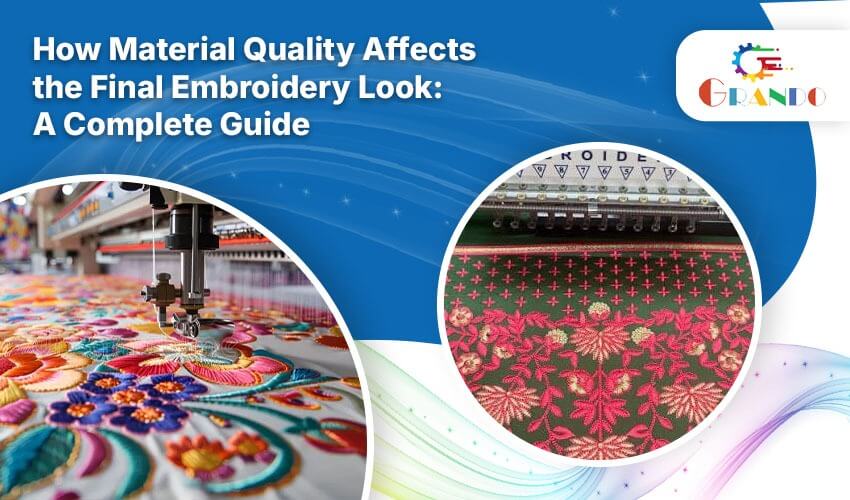
The finish of an embroidered design depends on far more than the machine running it. Material quality plays a decisive role in how clean, durable, and professional the final embroidery looks. Fabric weave, weight, and stretch affect stitch formation, thread tension, and pattern accuracy from the very first pass of the needle. For garment manufacturers, uniform producers, and branding businesses across Surat, Gujarat, and India, understanding this relationship is the difference between consistent, sellable output and a batch full of rework.
In this guide, we break down exactly how fabric quality shapes embroidery precision, which materials perform best, how to avoid the most common quality issues in production, and which embroidery machine in Surat is right for your fabric and order volume.
Why Fabric Quality Is the Foundation of Embroidery Precision
Every embroidery machine, no matter how advanced, relies on the fabric holding its shape under repeated needle penetration. A tightly woven, stable fabric keeps stitches aligned and prevents the pulling or bunching that distorts a design. Loosely woven or low-density fabrics move under tension, causing thread breaks, skipped stitches, and visible puckering around dense areas like logos or lettering.
This is why fabric quality directly affects embroidery precision, stitch consistency, and overall production efficiency. A production floor working with unpredictable fabric batches will always see higher rework rates and slower throughput than one working with quality-controlled material.
How Different Fabric Types Affect Embroidery Results
Not all fabrics behave the same way under a needle. The table below outlines how common materials typically perform in embroidery production.
| Fabric Type | Embroidery Behaviour | Recommended Stabilizer |
| Cotton (tightly woven) | Excellent stitch definition, minimal shifting | Tear-away, medium weight |
| Polyester blends | Stable, holds fine detail well | Cut-away, light to medium |
| Denim / Twill | Very stable, ideal for dense logos | Tear-away or no-show mesh |
| Silk / Chiffon | Delicate, prone to puckering | Wash-away, lightweight |
| Stretch knits | Can distort without support | Cut-away, heavyweight |
Common Embroidery Problems Caused by Poor Fabric Quality
- Puckering: Loosely woven or lightweight fabric bunches around dense stitch areas.
- Thread breaks: Rough or uneven weaves increase friction, snapping thread mid-run.
- Misaligned designs: Fabric shift during stitching causes logos or text to drift off-center.
- Show-through: Thin fabric allows underlying stitches to be visible from the front.
- Inconsistent batches: Variable fabric quality across a production run creates visible differences between finished garments — a major issue for uniform and bulk branding orders.
For businesses producing embroidered uniforms, corporate branding, or promotional apparel at scale, fabric consistency is as important as the embroidery machine’s own precision. One weak batch can affect the overall perception of an entire production run’s quality.
How to Choose the Right Fabric for Embroidery Projects
Selecting the right material comes down to matching fabric weight and weave to the design’s stitch density. Dense logos and lettering need stable, tightly woven fabrics such as twill, denim, or medium-weight cotton. Lighter, more delicate fabrics can still carry fine embroidery, but only with the correct stabilizer and reduced stitch count to avoid distortion.
Production teams should also test fabric batches before committing to full runs, particularly when sourcing from new suppliers. Small variations in thread count or fabric finish can noticeably affect embroidery precision and print resolution of the final design, even when using the same machine settings.
Where Embroidery Meets Digital Textile Production
Many textile manufacturers in Surat and across India now run embroidery alongside digital fabric printing to offer combined branding and decoration services. In both processes, material quality remains the common thread — the same fabric properties that affect embroidery stitch quality also influence ink absorption, color reproduction, and print resolution in digital textile printing. Businesses that standardize fabric quality across both processes see stronger production efficiency and more consistent output across their entire product line.
Grando India works with textile manufacturers, garment units, and branding businesses across Gujarat and India, supporting both embroidery and digital textile printing operations with equipment built for consistent, production-grade results.
Thread and Needle Quality: The Overlooked Half of the Equation
Fabric gets most of the attention, but two supporting materials quietly decide whether that fabric’s potential is actually realized: thread and needle selection. Even a premium, tightly woven fabric will produce a mediocre result if paired with low-grade thread or the wrong needle size.
Low-quality thread tends to show up as inconsistent sheen, frequent snapping mid-run, and color that dulls or shifts after a few washes — issues that get blamed on the fabric or machine when the thread is actually the weak link. Needle mismatch causes its own set of problems: too fine a needle on heavy fabric bends or breaks under repeated penetration, while too coarse a needle on delicate material leaves visible holes around the stitch line. As a general rule, needle size should scale with fabric weight, and needles should be replaced on a fixed schedule rather than run until they fail.
Lightweight fabrics such as chiffon, georgette, and organza need the lightest touch — fine needles, low tension, and light stabilizer — because they shift and pucker easily. Medium-weight materials like rayon and cotton blends are the most forgiving and typically need the least adjustment. Heavier materials such as velvet and upholstery-grade fabric need a firmer needle and stronger backing to prevent thread from sinking too deep into the pile.
Test Before Committing to a Full Production Run
One habit separates production units with consistently low rejection rates from those that firefight quality issues after the fact: running a small embroidery test on the actual fabric batch before committing to full-scale production. A test run reveals how a specific fabric lot behaves under the needle, whether the planned stabilizer holds, and whether stitch density needs adjusting — all before hundreds of meters of material are at risk. This is especially worthwhile when sourcing a new fabric supplier or switching between fabric lots, since even minor variation in weave or finish between batches can change embroidery behaviour.
Which Grando Embroidery Machine Suits Your Fabric?
Once fabric quality and stitch density are matched correctly, the next decision is choosing the right embroidery machine in Surat for your production volume and design complexity. Grando offers a full range of machines built for different fabric types and order sizes:
| Machine Type | Best Suited For |
| Single Head Embroidery Machine | Small batches, sampling, custom patch embroidery, and detail-heavy designs |
| Double Head Embroidery Machine | Mid-volume production needing two garments stitched in parallel |
| High Speed Computerized Embroidery Machine | Commercial embroidery machine setups running large, repeat orders on stable fabrics |
| Single Sequin and Cording Computerized Embroidery Machine | Sequin embroidery, beads embroidery, and decorative cording on fashion and bridal wear |
Beyond Machines: Embroidery Services and Support from Grando
Fabric quality is only one part of a consistent embroidery output — design accuracy and machine upkeep matter just as much. Grando India’s embroidery digitizing service converts artwork and logos into stitch-ready files calibrated to the fabric type being used, reducing the trial-and-error that leads to puckering or misalignment on the shop floor.
Grando also supports businesses across Surat and India with all garment machine services and spare parts, helping production units keep single-head, double-head, and commercial embroidery machines running at consistent tension and speed. This is particularly important for units offering custom patch embroidery, sequin embroidery, or beads embroidery, where even minor mechanical drift can show up clearly in the finished design.
Related Reading:
- Computerized Embroidery Machine Guide: Features, Types & Benefits
- Grando Embroidery Machine in Surat: Boost Creativity & Business Growth
- Direct to Fabric Digital Textile Printer | Grando India
Not Sure Which Embroidery Machine in Surat Suits Your Fabric?
Whether you need a single-head embroidery machine for custom patch work or a commercial embroidery machine for high-volume orders, Grando India’s Surat team offers free fabric-compatibility consultations, live demonstrations, and support on spare parts and servicing.
Request Your Free Consultation
Frequently Asked Questions
1. Why does fabric material quality matter for embroidery?
Ans: Fabric quality determines how well threads grip, how stitches hold their shape, and how sharp the final design looks. Unstable fabrics cause puckering, thread breaks, and misaligned patterns, while tightly woven, quality materials support clean, consistent embroidery.
2. Which fabrics are best suited for high-quality embroidery?
Ans: Tightly woven cottons, mid-weight polyester blends, twill, and denim generally hold embroidery best due to their stability. Delicate fabrics like silk can still be embroidered well with the correct stabilizer and reduced stitch density.
3. Can poor fabric quality damage an embroidery machine or design?
Ans: Yes. Loosely woven or overly stretchy fabrics shift under the needle, causing thread breaks, needle deflection, and skipped stitches, which distort the design and increase wear on machine components over time.
4. What role do stabilizers play in embroidery on different materials?
Ans: Stabilizers support the fabric during stitching to prevent puckering and shifting. Lightweight fabrics need tear-away or wash-away stabilizers, while stretch fabrics require cut-away stabilizers for lasting shape retention.
5. How does fabric quality affect embroidery on branded or uniform apparel?
Ans: Consistent fabric quality ensures every piece in a production batch carries the same crisp logo and stitch density. Inconsistent fabric batches create visible variation across garments, affecting brand presentation at scale.
6. Does Grando India provide guidance on fabric selection for embroidery machines?
Ans: Yes. Grando India, based in Surat, Gujarat, supports textile businesses across India with computerized embroidery machines and practical guidance on fabric compatibility, stabilizer selection, and machine settings for consistent results.