
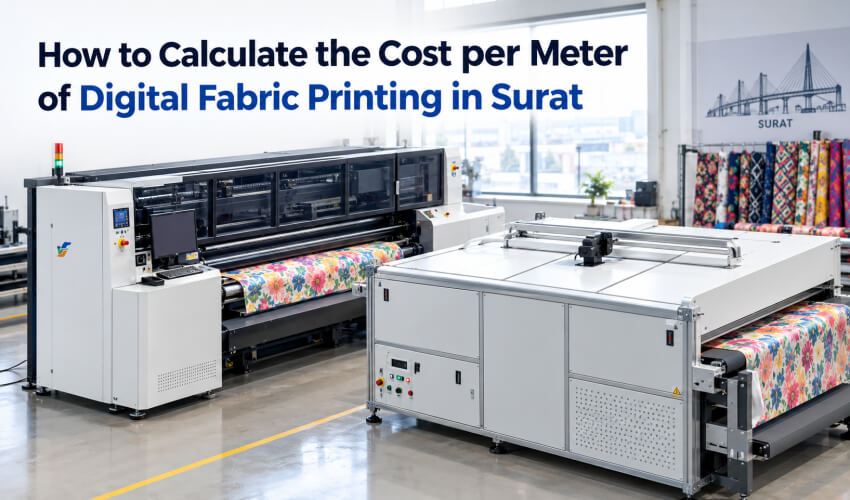
Understanding the cost per meter of digital fabric printing is essential for textile manufacturers and printing businesses that want to improve profitability in Surat. Whether you print saree fabrics, dress materials, fashion textiles, home furnishings, or customized fabrics, knowing your actual production cost helps you set competitive prices and manage expenses.
A modern Digital textile printing machine offers flexibility, detailed designs, and efficient production for different order sizes. However, the cost of printing each meter depends on several factors, including ink consumption, fabric type, electricity, labour, machine maintenance, and production speed.
For businesses in Surat’s competitive textile market, calculating these expenses accurately can help reduce unnecessary waste, prepare better customer quotations, and determine whether a new digital printing machine is a worthwhile investment.
Understanding modern digital fabric printing technology can also help businesses evaluate suitable printing processes. For a broader overview of available equipment and technologies, explore our digital textile printing machine guide.
This guide explains how to calculate digital fabric printing cost per meter and what to consider before investing in printing equipment in 2026.
What Is the Cost per Meter of Digital Fabric Printing?
The cost per meter of digital fabric printing is the total expense of producing printed fabric divided by the number of usable printed meters produced.
It includes variable expenses, such as ink and fabric wastage, along with allocated operating expenses, such as electricity, labour, maintenance, and machine depreciation.
Simple formula:
Cost per meter = Total printing production cost ÷ Total usable printed meters
For example, if a printing unit spends ₹12,000 to produce 1,000 usable meters of fabric, its production cost is ₹12 per meter.
This is an illustrative calculation, not a fixed market rate. Actual costs vary according to fabric specifications, print coverage, ink prices, machine configuration, and production conditions.
It is also important to distinguish between printing cost and selling price. Your selling price may need to cover blank fabric, pretreatment, finishing, packaging, transportation, overheads, and profit, depending on the services you provide.
For another perspective on calculating printing expenses, see this external resource on digital printing cost per meter.
7 Factors That Affect Digital Fabric Printing Cost per Meter
1. Ink consumption and print coverage
Ink is one of the most important components of digital fabric printing cost per meter. Designs with large solid-colour areas, dense patterns, or heavy coverage may consume more ink than light, minimal designs.
Ink consumption also depends on the printer, printhead configuration, ink type, colour settings, fabric, and print resolution.
How to manage it: Test actual ink consumption on representative designs, maintain suitable colour profiles, and avoid unnecessarily high ink limits. For suitable polyester applications, choosing compatible sublimation printer ink is an important part of evaluating operating costs.
2. Fabric type and preparation
Cotton, polyester, silk, and blended fabrics can require different printing technologies and preparation processes.
A sublimation inkjet printer is commonly used for suitable polyester applications. Other fabrics may require different ink systems, pretreatment or finishing processes. These requirements can significantly change the final cost.
How to manage it: Select a printing process that matches the fabric composition, end use, colour requirements, and expected production volume.
3. Electricity consumption
Your fabric printing machine operating cost includes the electricity required to run the printer and supporting equipment. Dryers, heaters, steaming equipment, washing systems, and finishing machinery may add to the total energy expense.
To estimate electricity cost per meter, divide the electricity expense attributable to production by the usable meters printed during the same period.
4. Labour and production efficiency
Operators may be responsible for preparing artwork, loading fabric, monitoring print quality, changing jobs, cleaning equipment, and handling printed rolls.
Frequent design changes, setup delays, and manual interventions can increase labour costs per meter.
How to manage it: Standardise job preparation, train operators, and organise production schedules to reduce avoidable downtime.
5. Machine maintenance and spare parts
Regular cleaning, preventive maintenance, printhead care, and timely replacement of worn components help maintain consistent print quality.
The cost of maintenance should be included in production planning rather than treated as an unexpected expense. Actual expenses depend on machine usage, operating conditions, component prices, and service requirements.
6. Fabric wastage and rejected prints
Misprints, colour inconsistencies, fabric misalignment, and setup waste increase the cost of every usable meter.
Effective color management in textile printing can help businesses maintain colour consistency and reduce avoidable test prints and rework.
For example, if a production run consumes 1,050 meters of material but only 1,000 meters pass quality inspection, the cost must be allocated across the 1,000 usable meters rather than the total material fed into the machine.
7. Production speed and machine utilisation
A machine’s advertised speed does not always equal its actual production output. Job changes, maintenance, fabric handling, and quality checks affect the number of usable meters produced per shift.
A machine with higher capacity may reduce allocated costs per meter when it is consistently utilised. However, the investment is worthwhile only if demand, quality, staffing, and operating conditions support that capacity.
How to Calculate Textile Printing Production Cost per Meter
Follow these steps to calculate your actual textile printing production cost.
Step 1: Calculate total production expenses.
Add the costs associated with the printing process:
- Ink and other printing consumables
- Fabric preparation and pretreatment, where required
- Electricity and other utilities
- Labour and quality inspection
- Machine maintenance and spare parts
- Machine depreciation and production overheads
- Waste and rejected prints
Include the raw fabric cost only if your business supplies the fabric as part of the order.
Step 2: Calculate usable output.
Measure the total meters that pass quality inspection and are suitable for delivery. Do not count rejected prints as saleable output.
Step 3: Divide total expenses by usable output.
For example, if the total printing expense is ₹25,000 and the finished, saleable output is 2,000 meters:
Cost per meter = Total printing production cost ÷ Total usable printed meters
Your illustrative printing production cost is ₹12.50 per usable meter. This figure excludes any expenses not included in the ₹25,000.
For wider fabrics or jobs with different widths, it is often better to calculate cost per square meter first and then convert it to a linear-meter rate. This makes comparisons more meaningful.
How Can Textile Businesses in Surat Reduce Printing Costs?
Surat’s textile businesses often need to balance production volume, design variety, turnaround time, and print quality. The following practices can help improve cost control.
- Choose the right printing technology: Match the machine and ink system to the fabric, design, and required finish.
- -Track ink usage: Compare ink consumption against saleable output instead of relying on a generic estimate.
- Reduce setup waste: Check artwork, fabric alignment, colour settings, and machine condition before full production.
- Schedule similar jobs together: Where practical, group compatible jobs to reduce setup time and avoid unnecessary cleaning cycles.
- Maintain the machine regularly: Follow manufacturer recommendations to reduce preventable downtime and print defects.
- Review actual production data: Compare estimated and actual costs monthly to identify rising expenses.
A digital textile printing machine should be evaluated on more than its purchase price or advertised speed. Consider actual output, operating expenses, service support, consumable availability, and the type of work you expect to produce.
How to Choose a Digital Fabric Printing Machine for Your Business
Before investing in a new machine, identify your typical fabric types, average order volume, print width, design complexity, and production targets.
Ask the supplier about achievable output under your intended operating conditions, compatible inks, maintenance schedules, installation, operator training, and spare-parts availability.
If you are upgrading an existing printing unit, compare the expected cost per saleable meter of your current setup with the projected cost of the new machine. Use realistic production volumes rather than assuming that the machine will run at full capacity every day.
For suitable applications, compare the capabilities of a direct-to-fabric digital textile printer against your fabric composition, production requirements, and finishing process.
For Surat-based textile manufacturers, choosing suitable machinery can support better production planning and more consistent output. The right decision depends on your business requirements, not simply on selecting the fastest or least expensive machine.
Frequently Asked Questions
Q1. What is the cost per meter of digital fabric printing in Surat in 2026?
Ans: There is no single rate for every fabric and printing method. The final cost depends on ink consumption, fabric type, print coverage, processing requirements, machine utilisation, and wastage. Calculate it using your own production data for a reliable estimate.
Q2. How do I calculate digital fabric printing cost per meter?
Ans: Add the relevant printing and operating expenses, then divide the total by the number of usable printed meters. Include fabric, finishing, or other services only if they are part of your costing scope.
Q3. Which factors increase fabric printing machine operating cost?
Ans: High ink consumption, excessive setup waste, low machine utilisation, frequent maintenance, energy consumption, and rejected prints can all increase operating costs.
Q4. Can a digital textile printing machine reduce production costs?
Ans: It can improve efficiency for suitable jobs, particularly where design flexibility and shorter production runs are important. Actual savings depend on machine utilisation, process requirements, print quality, and the cost of the existing production method.
Q5. How can I estimate printing costs before buying a machine?
Ans: Prepare a production estimate using expected output, ink consumption, electricity, labour, maintenance, consumables, and saleable yield. Ask the supplier to help validate the assumptions for your fabric and intended designs.
Get a Cost-Based Machine Recommendation from Grando
Want to understand which digital textile printing setup fits your production budget? Grando can help you explore suitable printing machinery based on your fabric type, printing requirements, and expected output.
Share your daily production target and the fabrics you print to discuss an appropriate machine configuration and the operating factors to consider.
Learn more about Grando’s technical support and services or contact the team for a machine consultation and quotation.
Phone: +91 93777 77071
Email: grando.co.in@gmail.com