
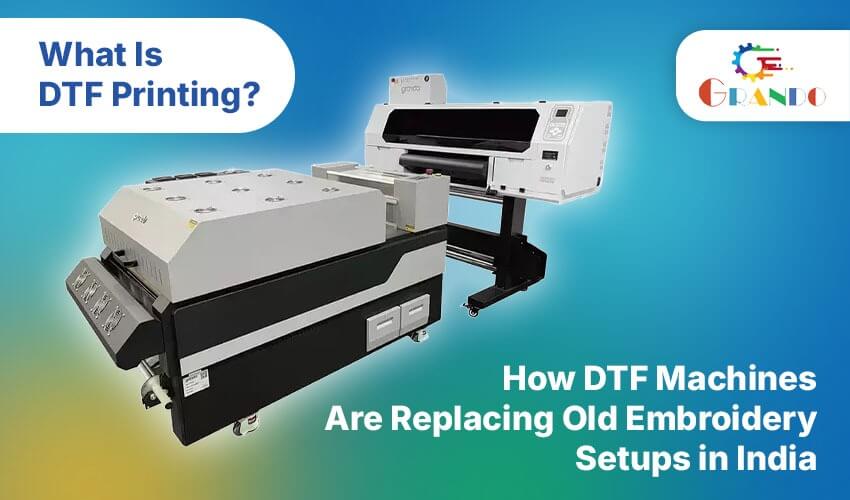
Introduction: Is DTF Printing Changing India’s Textile Business?
Imagine running a garment printing business where a customer walks in with an order for 25 T-shirts — each featuring a different name, colourful artwork, and a detailed logo. With a traditional embroidery setup, you may need digitised designs, thread changes, and additional machine time. For complex artwork, the process can become time-consuming.
Now imagine printing those designs digitally onto transfer film and applying them to garments using a heat press.
That’s where DTF printing (Direct-to-Film printing) comes in.
Across India’s garment customisation and textile printing sector, businesses are exploring DTF technology to handle personalised apparel, small-batch orders, detailed graphics, and faster design changes. DTF doesn’t make embroidery obsolete — it gives business owners another way to meet changing customer demands.
What Is DTF Printing?
DTF printing is a digital textile printing method in which a design is printed onto a special PET transfer film, coated with heat-activated adhesive powder, cured, and transferred onto fabric using a heat press. It allows businesses to apply detailed, multicolour graphics to many compatible light and dark garments.
Unlike embroidery — which uses thread to create a stitched design — DTF uses printed colours and an adhesive layer to reproduce artwork on fabric.
How Does DTF Printing Work?
The process generally involves five stages:
- Design preparation:Create the artwork using graphic design software and prepare the file for printing.
- Film printing:Print the design onto PET film using dedicated DTF inks, typically including CMYK colours and a white ink layer for dark garments.
- Powder application:Apply hot-melt adhesive powder to the printed areas and remove excess powder.
- Curing:Heat the printed film to melt the adhesive powder according to the consumables and equipment manufacturer’s instructions.
- Heat transfer:Position the transfer on the garment, apply the specified temperature, pressure, and time, then peel the film as directed.
The finished garment should be checked for adhesion, colour quality, and resistance to washing before delivery. Kodak’s DTF application guide provides a detailed technical overview of these stages.
Which Fabrics Can DTF Printing Handle?
Depending on the ink, film, adhesive, garment construction, and application settings, DTF can be suitable for:
- Cotton T-shirts and sweatshirts
- Polyester sportswear
- Cotton-polyester blended garments
- Hoodies and promotional apparel
- Selected uniforms, bags, and other textile products
Business Example
A Surat-based custom apparel shop could use DTF to produce personalised T-shirts for a college event, staff uniforms for a local business, or branded merchandise for an online clothing store. The same basic workflow can accommodate different designs without creating a separate embroidery file for every graphic — that flexibility makes DTF particularly relevant for businesses serving customers who want smaller quantities, colourful artwork, and frequent customisation.
Why Are Indian Businesses Considering DTF Instead of Traditional Embroidery?
Traditional embroidery has long been a popular choice for company uniforms, school logos, polo shirts, caps, and premium clothing. It creates a raised, textured finish that many customers associate with quality and durability.
However, not every design or customer order is suited to embroidery. A detailed illustration with gradients, photographic elements, or many colours may be difficult or expensive to reproduce using stitches. Embroidery also requires digitising artwork into a stitch pattern, setting up the machine, and managing thread colours and stitch density.
DTF offers a practical alternative for these situations.
1. More Freedom with Colourful Designs
DTF can reproduce gradients, fine lines, and complex multicolour artwork without changing threads for every colour. This is particularly useful for fashion graphics, gaming merchandise, and promotional T-shirts.
2. Better Flexibility for Personalised Orders
Businesses can prepare different designs on film and transfer them to individual garments. This makes DTF useful for customised names, limited-edition apparel, and print-on-demand orders.
3. A Workflow That Can Be Scaled
Automated powder application and curing systems can reduce manual handling and improve production consistency. The actual output depends on the printer, artwork, print settings, and transfer workflow.
DTF can also help existing embroidery businesses expand their services rather than replace their equipment. A shop could offer embroidered chest logos alongside printed back graphics, for example. The key point is that DTF is changing how businesses approach certain garment orders — not eliminating embroidery, screen printing, or other textile decoration methods.
DTF Printing vs Embroidery: Which Is Better for Your Business?
The right choice depends on the artwork, garment, order quantity, customer expectations, and total production cost.
| Factor | DTF Printing | Traditional Embroidery |
|---|---|---|
| Design style | Detailed graphics, gradients, full-colour artwork | Stitched logos, lettering, textured designs |
| Setup | Digital artwork preparation and printer setup | Digitising, hooping, thread and machine setup |
| Small personalised orders | Often practical | Depends on stitch count and setup cost |
| Design appearance | Flat printed transfer | Raised, stitched finish |
| Fabric suitability | Many compatible fabric types | Many fabrics, subject to garment and machine suitability |
| Large production runs | Depends on printer capacity and workflow | Depends on machine heads, stitch count, and setup |
| Maintenance | Printhead, ink, film, powder and curing-system care | Needles, thread tension, hoops and machine maintenance |
| Best applications | Graphic T-shirts, personalised apparel, colourful designs | Corporate logos, caps, polo shirts, premium uniforms |
A Practical Example for an Indian Printing Business
Suppose a customer orders 30 black T-shirts for a college festival. Each shirt needs a colourful graphic, and the names differ. With DTF, the business can print the designs on film and apply each transfer to the appropriate garment. With embroidery, reproducing the same detailed artwork may require substantial digitising and stitching work.
Now consider a different order: 500 corporate polo shirts with a small, one-colour chest logo. Embroidery may be the more suitable option because the customer wants a professional stitched appearance and the order can support efficient repeat production.
What Should You Check Before Investing in a DTF Machine in India?
Buying a DTF printer is a business decision, not just an equipment purchase. Before investing, consider the type of customers you want to serve and the number of garments you expect to produce.
Essential Equipment for a DTF Setup
- DTF printer: Choose a machine with suitable print width, resolution, production speed, and white-ink management.
- Powder shaker and curing unit: Manual systems may suit smaller operations; automated systems can support higher production requirements.
- Heat press: Look for consistent temperature, pressure, and timing across the entire transfer area.
- Consumables: Budget for PET film, compatible DTF inks, adhesive powder, cleaning supplies, and replacement parts.
- Design software and workflow: Ensure your RIP software, colour profiles, and artwork process are compatible with the printer.
- Technical support: Check spare-part availability, operator training, warranty terms, and local service support.
Calculate Your Actual Production Cost
Don’t compare machines only by their purchase price. Calculate the cost of producing each finished garment.
Include:
- Ink, film, adhesive powder, and electricity
- Garment cost, if you supply the T-shirt
- Labour and machine maintenance
- Wastage, rejected prints, and reprints
- Packaging, delivery, and overheads
Request a live demonstration and test your own artwork on the fabrics you intend to print. Ask the supplier to demonstrate print quality, transfer adhesion, production output, and wash performance before committing.
Is DTF Printing the Right Opportunity for Your Textile Business?
DTF printing may be worth exploring if your customers regularly request personalised T-shirts, multicolour graphics, short production runs, or designs that are difficult to embroider economically.
It can also help existing printing shops expand into online merchandise, event apparel, sportswear, and custom clothing — without requiring a complete overhaul of the existing setup.
However, success depends on more than owning a machine. Consistent print quality, suitable consumables, reliable maintenance, competitive pricing, and repeat customers all matter.
Before investing, evaluate local demand, calculate your break-even point, and compare manual and automated production options. Start with sample orders, gather customer feedback, and expand production when your order volume justifies it.
Key Takeaways
- DTF printing is well suited for colourful graphics, gradients, personalised orders, and designs that are complex to embroider.
- Embroidery remains the preferred choice for raised logos, premium uniforms, caps, and customers who expect a stitched finish.
- The right technology depends on your order type, customer expectations, artwork style, and production economics — not a single universal answer.
- Many Indian garment businesses benefit from offering both methods rather than replacing one with the other.
- Before investing in equipment, test with your own artwork and garments, and calculate per-unit production cost including consumables, labour, and maintenance.
- Local demand, break-even analysis, and supplier support quality should all be verified before a capital purchase.
Frequently Asked Questions About DTF Printing
1. What is DTF printing, and how does it work?
Ans: DTF printing stands for Direct-to-Film printing. A design is printed onto PET film using dedicated inks, adhesive powder is applied and cured, and the transfer is pressed onto fabric using a heat press. The method is compatible with many light and dark garments across cotton, polyester, and blended fabrics.
2. Is DTF printing better than embroidery?
Ans: Neither method is universally better. DTF is often the practical choice for colourful graphics, photographic designs, and personalised small orders. Embroidery is often preferred for raised logos, caps, premium uniforms, and customers who specifically want a stitched finish. The right choice depends on your artwork and order type.
3. Can DTF printing completely replace an embroidery machine?
Ans: Not in every business. DTF can handle design requirements that embroidery cannot reproduce economically — particularly detailed, multicolour artwork. But it cannot replicate the raised-thread appearance that many corporate and premium uniform customers expect. Most growing garment businesses benefit from offering both technologies.
4. Which fabrics can be used for DTF printing?
Ans: DTF works on cotton, polyester, and many blended fabrics, along with selected other materials. Compatibility depends on the film, adhesive, ink system, fabric coating, and heat tolerance of the specific garment. Always test before bulk production, particularly on heat-sensitive, coated, or performance fabrics.
5. Is DTF printing profitable in India?
Ans: It can be profitable when local demand, pricing strategy, production efficiency, and operating costs are aligned. Businesses should calculate consumables, labour, electricity, maintenance, wastage, and overheads carefully. No machine guarantees a specific return — profitability depends on how the technology is integrated into your overall business model.
Stop Turning Away Orders.
Get a Live Machine Demo Before You Decide.
Most business owners make DTF investment decisions based on brochures and price lists. Our experts walk you through a live production run — your artwork, your fabric, your transfer settings — so you see exactly what the machine delivers before spending a rupee.